
Shangri-La Development Association (SDA), a team of energetic professionals, is a non-profit and non-governmental organisation that works on improving the lives of the Chepang community and hard of hearing students through integrated activities in Health, Education and Agriculture.
Registered on 10th November 2014 in the local administrative body of the Nepal Government, SDA eventually became the partner of Govinda Association /Shangri-La Association on 1st December 2014.
A Brief History On What Led To Reconstruction Projects
After only four months of SDA’s establishment, an earthquake of 7.8 on the Richter scale struck Nepal on 25th April 2015 at 11:56 local time. The catastrophic disaster claimed more than 10,000 lives, displaced hundreds of people and inflicted substantial damage to the infrastructures. 5003 schools in 14 districts were damaged.
Immediately after the earthquake, the proposal for the reconstruction of schools and the construction of Literacy Home got approved on 8th October 2015 by the Social Welfare Council as School Building Reconstruction and Education Support Project (SBRES).
Parallel to SBRES, Shangri-La Reconstruction and Development Project (SRDP) also was started by
Govinda Development Aid Association (GDAA), Aalen, Germany
Shangri-La Development Aid Association, Zurich, Switzerland
Usthi Foundation, Zurich, Switzerland
Shangri-La Development Association (SDA), Makwanpur/Lalitpur, Nepal
Shangri-La Orphanage Home (SOH), Lalitpur, Nepal
Both SRDP and SBRES are not part of regular activities in the Health, Education and Agriculture of the organisation.
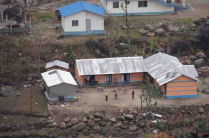
The target areas of SRDP for reconstruction were Lalitpur and Makwanpur districts. The selection of the former location was upon the proximity of Shangri-La Orphanage Home/ Shangri-La International School, also situated in the Lalitpur district. And in Makwanpur, the target regions were the VDCs of Kalikatar and Bharta now known as Kailash Rural Municipality, predominantly populated by the Chepang community.
A person had died in the Kalikatar and Bharta VDCs of Makwanpur. And, out of 796 households in Kalikatar and 693 in Bharta, 313 private houses were damaged. The earthquake had destroyed 13 school buildings as well.
In the same way, the number of private houses that got destroyed and partially damaged in Lalitpur were 17,444 and 8064, respectively. The death toll reached 180, and 149 of 200 government schools also were destroyed.
The aftershocks kept occurring for months, intensifying the risks of possible landslides. A political blockade of the border with Nepal by India that followed aggravated the situation.
The organisations who had initiated SRDP also distributed 55 tons of relief supplies as emergency aid to 11 of the 14 most affected districts of Nepal. A hundred and twenty-six communities and 36,414 people received the relief packages within a month.
More than 5,000 people received temporary accommodation as monsoon aid support. Learning of around 2500 students was ensured with temporary learning centres. In addition, more than 600 people received hygiene training and medical care.
ODHR – Owner Driven Housing Reconstruction
ODHR, as practised in the first completed reconstruction in Nepal after the Earthquakes of 2015 in SRDP and SBRES, is a participatory and sustainable habitat that promotes social cohesion and increases self-reliance. The disaster affected areas of Pakistan, Haiti, India, and Sri Lanka have had successful implementations of ODHR before.
Part of ODHR is a long start-up period marked by assessments and participatory planning. Compared to other housing projects, there are overall lower costs for one house but higher expenditures because of supervision and assessments.
SDA carried out close observations of principles such as: the participatory process of decision making, adequate technical support (design, approvals, training, technical assistance, supervision), financial assistance, and a complete graphic of ODHR in SRDP for the implementation of ODHR.
Completion of the first Owner Driven House Reconstruction in Nepal
In August 2016, it became possible to complete the first owner-driven reconstruction in Nepal and 104 earthquake-resistant houses under SRDP. It was the first-ever implementation of ODHR methodology in Nepal.
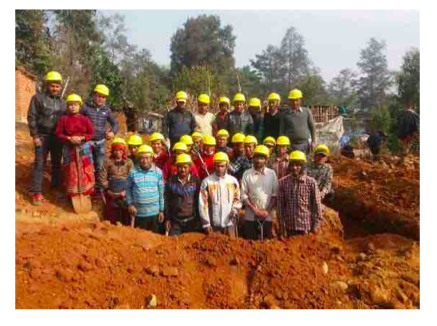
A total of 126 masons and carpenters received certified skill training, and 431 workers/ board members were involved in accomplishing these challenging tasks under the most demanding circumstances in Nepal.
CDSR – Community-Driven School Reconstruction
Involving the community is often underestimated, yet a crucial factor in development cooperation.
The decision to imply a self-contribution scheme was an important developmental factor, widely practised in Nepal and was part of the previous 12 Shangrila/ Govinda school constructions for more than 4000 children in four districts in Nepal.
We have a long history of constructing schools uniting with the local communities. Besides, involving the community close to the whole process (CDSR) led to a higher sense of ownership than standard reconstruction projects where local communities are merely passive recipients. As a result, the project cost also decreased.
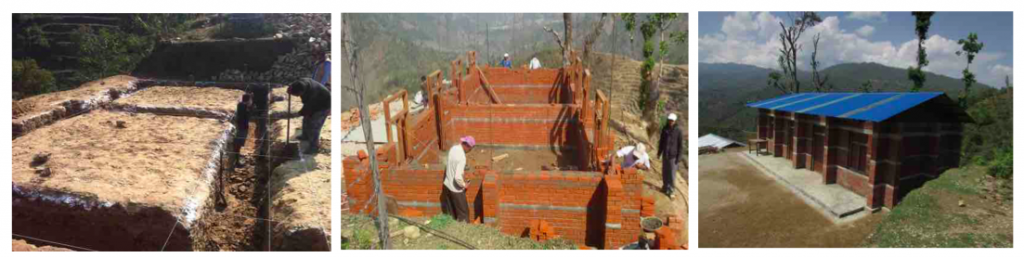
Skill and Technology Transfer
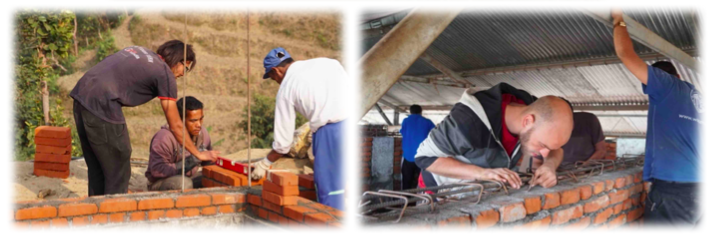
SDA undertook the construction with the local workers to involve them in developing their area and reap the benefit of constructed schools. The project entailed applying skills and technology transfer concepts for the local people to learn about earthquake-safe construction.
The masons received training first and sat for exams for certification from SDA later. Training took place as a one-by-one model with certified, experienced masons from Kathmandu who have been trained and employed in the previous reconstruction projects I-III.
The SDA site engineer and supervisor and an experienced trainer from the SDA side assured the quality of training and the earthquake safety of the buildings.
How did SDA achieve CDSR?
We have seen plenty of completed construction projects neglected for maintenance. Perhaps, it is about not finding the right balance of involving local communities, which has cost the quality and other resources invested in projects. Thus, the tailoring of projects to meet the social and cultural context is necessary.
And that is what SDA exactly did in Makwanpur: a place with a high illiteracy rate, low awareness levels, high poverty, and an extremely underprivileged target group.
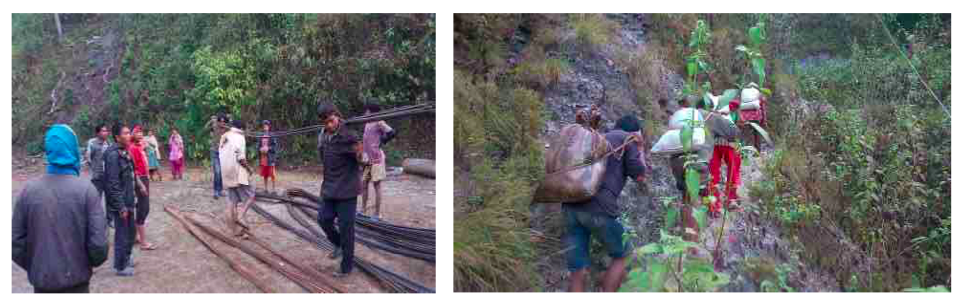
Community fellows procured and transported most materials such as stones, wood, mud, bricks, and sand for the construction and received cash as payment. The involvement of the community, School Management Committee (SMC) and School Reconstruction Committee (SRC) made it much easier in planning the procurement and construction of the schools.
There were regular meetings to discuss the collection of materials, transportation and working time (cultivation time was pre-decided). Locals sat for a meeting with SMC and SAC and decided that the payment was as per the trend in the community so that it was social yet not overpriced.
People from the community also got some work on a contract basis. The project addressed men and women equally. Labour payment for men and women was the same as decided by the boards, while at the same time, women did not have to carry heavy loads. The involvement in decision making from the community was also equally addressed.
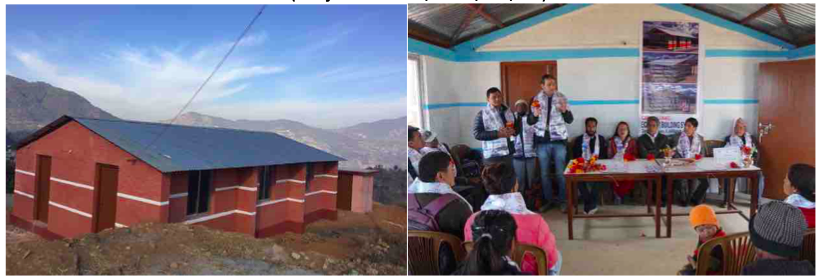
(Project of SOH/ SDA/GA/SA)
Sustainability of the Reconstruction Projects
Maintenance, a pivotal part of the sustainability of the structures, requires not only a sense of ownership but technical skills, financial resources, access to tools and follow-up inspections.
Training the local masons during the construction meant easy execution of possible maintenance needed in future. School designs handed over to the SMC have made it undemanding for the community to know about the makings of the buildings and multiply the structure should they desire.
After completing the construction, engineering companies did a thorough maintenance check. The engineering company and the external contractor for roof work were responsible for a liability period of 6 months for maintaining the houses.
Nevertheless, SMC and the community became responsible for the schools, confirmed and described in a “Memorandum of Understanding” (MoU) passed to the beneficiaries during the handover of the schools.
SDA is active in Makwanpur with Govinda- Germany, and Shangrila- Switzerland. So, there is no phasing out of the SBRES project. There will always be monitoring and supervision of the buildings.
Community Participation
The principle of owning the reconstruction process proved difficult for the beneficiaries in the previous SRDP. Proper implementation of board decisions and leadership avoided this problem in the school reconstruction, which resulted in successful community participation.
Importantly, local implementation, participation and integration of existing knowledge increased the sense of ownership immensely for the community people. The community was directly involved in all the planning stages and had a vital role in the implementation process through their contribution to ensure their ownership.
Target set before involving the community
Construction of four technically sound earthquake-resistant schools involving the communities for 924 students with lower damage risks to develop the higher capacity to rebuild a better and safer school in future if required.
Target achieved after involving the community
Construction of four technically sound earthquake-resistant schools, three toilets, two retaining walls, skill & technology transfer and equipment for all schools involving the communities for 924 students with lower damage risks to develop the higher capacity to rebuild a better and safer school in future if required.
Post Reconstruction Findings
Although the efficiency is decent, there is still some scope for improvement in planning and implementation. On the other hand, the project addressed the policies, priorities and needs, and reached its objectives in school reconstruction within the time frame of the cooperation contract.
“The school is one of the most qualitative and safe buildings that I have seen. Had it been finished, we would have conducted the election here.” – Security officer of Kalikatar for Local Election 2017