

Shangri-La Development Association (SDA) has been doing organic farming on its land in Kailash Rural Municipality (KRM) since 2014.
The farmland, nearly 17576 sq.m. sized, is located in ward no. 3 KRM called Latabari. The land consists of four parts: Kitchen Garden, Research Block, Mass Production and Agroforestry. Food from the land goes to SDA Literacy Home in Kalikatar and as mid-day meal to five different primary schools supported by SDA.
Under the Agriculture Project of SDA, different activities get carried out according to the prepared yearly Detail Implementation Plan (DIP). Seasonal and Off Seasonal Organic Vegetable Farming Training and Seed Distribution Program is one of the activities under the Agriculture project. This particular training is held every year in December.
The targeted group of this training are the farmers of working areas Kailash Rural Municipality ward no. 3 and 4. SDA has been working with four farmers groups since its establishment. The farmer groups are Ambatar Farmer group, Khirki farmer group, Lalupate Farmer group and Namobuddha Farmer group.
Seasonal and Off Seasonal Organic Vegetable Farming Training and Seed Distribution Program was conducted on the 27th and 28th of December 2021.
The facilitators for the training program were Babu Ram Shrestha, SDA’s consultant and expert for Agriculture Project for both days and Lalit Tiwari, coordinator for Agriculture Department, Kailash Rural Municipality, for the first day.
On the 27th, the first day of the training started with a formal program, followed by an orientation on basic concepts of Seasonal and Off Seasonal Organic Vegetable Farming from Lalit Tiwari. In addition, there was a visual presentation shown to help the farmers understand clearly.
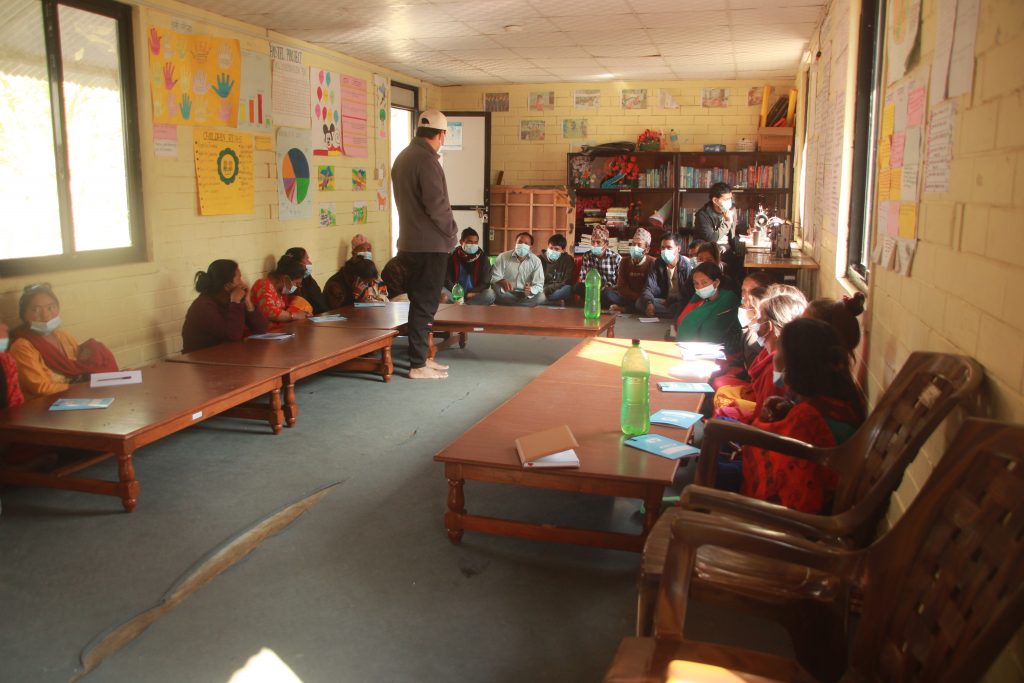
Thirty-one participants received theoretical classes on vegetable farming inside SDA Literacy Hall. The participants had the opportunity to learn about different theories of the importance and classification of seasonal and off-seasonal vegetable farming.
Moreover, the farmers gained knowledge about differentiating between seasonal and off seasonal vegetables and things to consider for off seasonal vegetable farming.
On the 28th, day two of the training, the participants received practical classes at SDA’s farmland in Latabari from the facilitator Babu Ram Shrestha. The farmers obtained various knowledge on making tree nursery beds, Effective Microorganisms (EM) solutions and hotbeds.
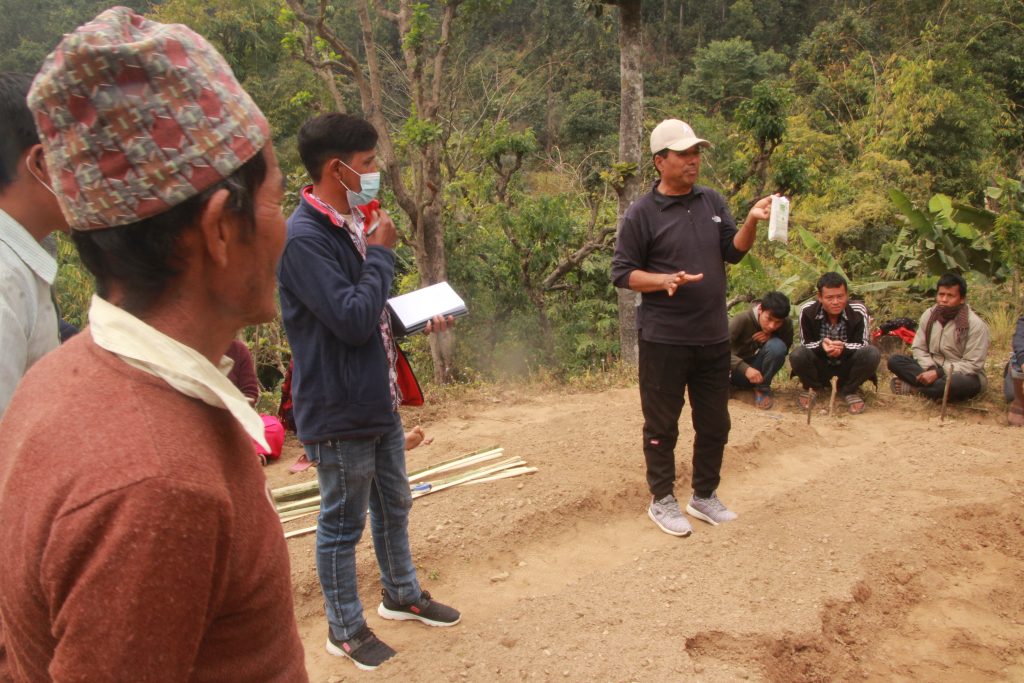
Likewise, the farmers learned techniques of fruit plantations, preparing plastic tunnel houses and coco peat mixing manure.
Facilitators of the training cleared the confusion and answered questions the participants had regarding Seasonal and Off Seasonal Organic Vegetable Farming.
The practical training concluded with seeds and EM solutions distribution program. Overall the training was a complete success, commemorated by taking group photos.
Every year, the Agriculture Project team conducts various training with different objectives. In the same way, this specific training also had its purpose.
Some of the main objectives of the training were transferring knowledge of organic vegetable farming to farmers of working groups, educating the farmers with organic ways to control the number of chemical pesticides and importantly, attracting the farmers towards organic farming.
Similarly, distributing seeds to the participants in the program, providing knowledge on tree nurseries, nutrients required for plants and methods to use them correctly.
Since the beginning, SDA has been adamant about promoting sustainability in all its projects. And the intention remained resolute during the Seasonal and Off Seasonal Organic Vegetable Farming Training and Seed Distribution Program.
With this training, the facilitators conveyed the significance of sustainability through organic farming. SDA is optimistic that the farmers have acquired an adequate understanding of producing at a low cost utilizing the resources available in and around the village.
Speaking of the village, a large proportion of Kalikatar’s population belongs to the Chepang community. They are one of the indigenous and marginalized communities of Nepal.
The people over there are uneducated and called the poorest of the poor. The number of malnourished children in Kalikatar and its neighboring localities is terrifyingly high. The absence of knowledge and resources explains the lack of nutritious food.
The farmers have been practicing traditional farming styles only. On top of that, they mostly plant crops and not vegetables. The crops they produce in a year only last for six months.
SDA’s agriculture project works on alleviating such problems through different activities. Out of many, the training was also to create awareness regarding organic vegetable farming on the grassroots level.
Organic vegetable farming means growing fresh and healthy greens using locally available sources. Plus, organic farming is cost-effective and yields fruits and vegetables high in nutrition. SDA is hopeful in mitigating the difficulties brought on by poverty and lack of education through organic farming.
The participant farmers seemed happier as they learnt about organic farming and their potential in improving the quality of whatever they produce. In the end, the farmers left the field feeling empowered, inspired and motivated to make better changes.
It is consequential that the message of implementing sustainable, environment-friendly and organic approaches while farming gets across to the farmers. Focusing on sustainability is not only for us but for the generations to come as well.