

Shangri-La Development Association (SDA) launched Education, Health and Agriculture projects targeting the Chepang and the disadvantaged communities in wards 3, 4 and 7 of Kailash Rural Municipality (KRM) in 2015.
SDA successfully carried out the project activities till 2019, but things took an unprecedented turn as 2020 began. Covid – 19 brought the entire world to a halt and, as a result, disrupted the project activities either partially or wholly.
Program Background
SDA ran its Agriculture and Heath project activities only in parts. But the Education project activities stopped since they are directly related to programs of the supported school, which were closed due to the Covid-19 global pandemic.
Covid-19 affected the economy locally and globally. Lakhs of migrant workers lost their jobs and, or returned to Nepal, tremendously affecting the remittance flow into the country. Millions of Nepalese faced employment issues due to the disruption led by the pandemic. Similarly, the lockdown created problems in the day-to-day life of people. People become jobless, especially those who earn wages by working as labourers. According to a study by the National Planning Commission, an estimated six million+ people became unemployed because of the pandemic.
Sometime during the lockdown, it reached a point where people were more scared of dying of hunger than the virus. It was harder for those who were already struggling to make ends meet. Among them were the communities of Chepangs and other ethnic groups living in the remote hills of Makwanpur in Kailash Rural Municipality.
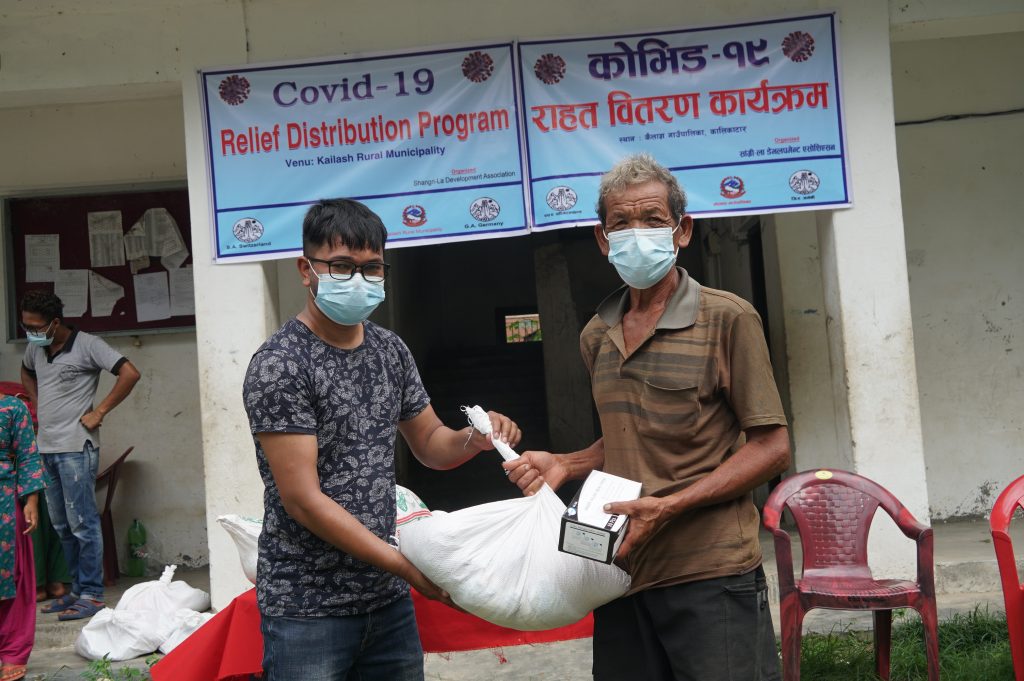
Hence, in light of the disaster, SDA decided to do something about it to help the vulnerable communities in its working area. Therefore, it conducted two Covid-19 Relief Distribution Programs during the first and the second wave of Covid-19 in 2020 and 2021, respectively.
Program Objectives
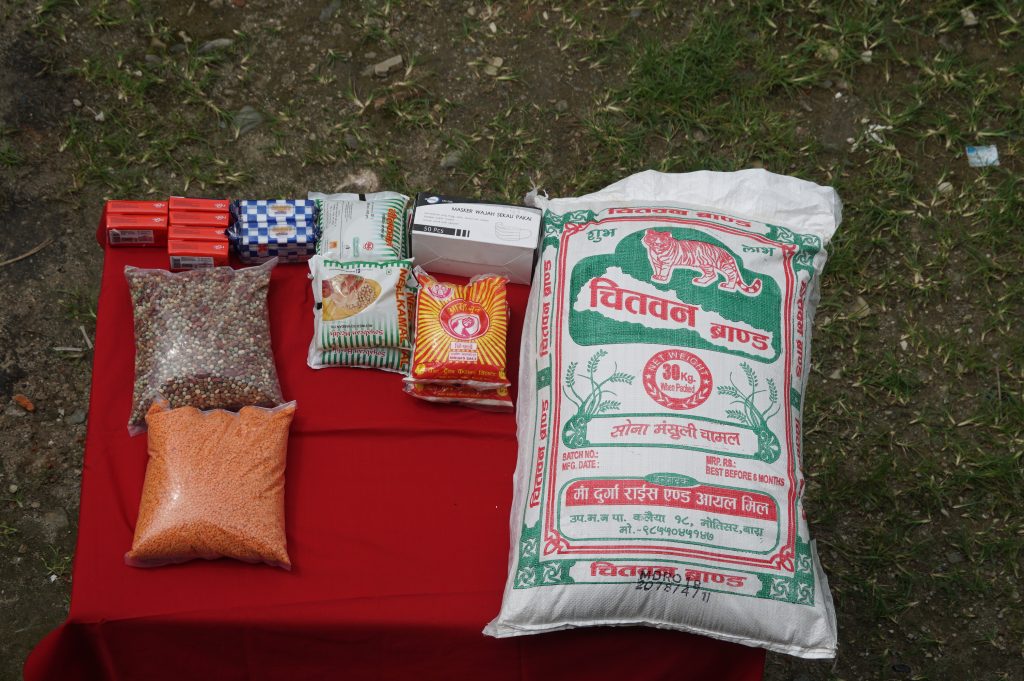
The priority of the relief distribution was for single women and poverty-stricken families. The relief packages included rice, cereals, salt, oil, lentils, washing soap, bathing soap, masala and masks.
Similarly, SDA could not provide the daily mid-day meals to the students of the schools it supports since they were closed. It led to an increase in the case of malnutrition in the area. And one effective way of mitigating malnourishment was to ensure that the children get proper food which the team planned to do via the relief supplies distribution program.
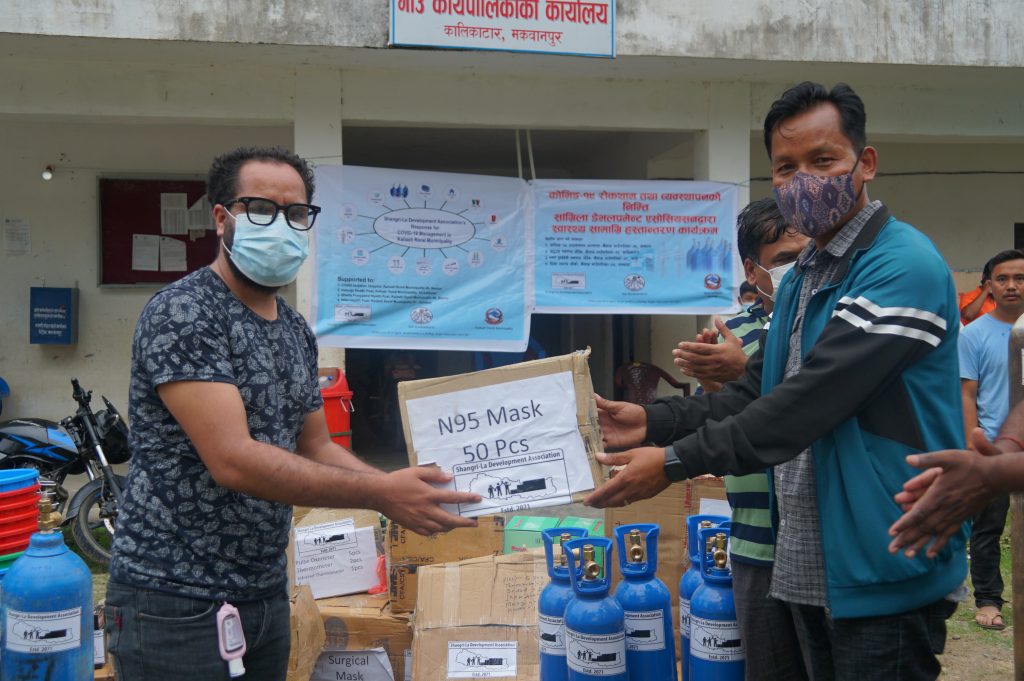
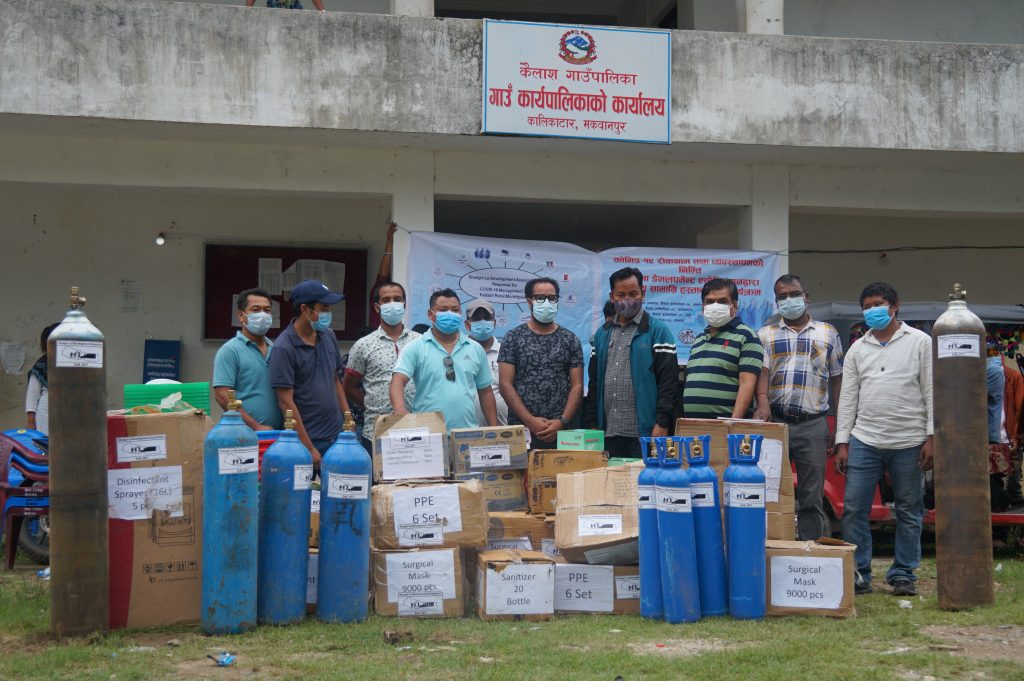
Furthermore, a covid – 19 isolation centre in the Namtar Hospital had a shortage of oxygen and other necessary equipment. It was a situation of life and death for many people. Thus, the SDA team decided to handover covid – 19 supplies to the isolation centre.
The utmost goal was to solve immediate food scarcity problems for poor and Chepang households in Kailash Rural Municipality. In precision, SDA wanted to support the needy families from wards no. 3, 4 & 7 in 2020 and wards 3,4,7 and 8 in 2021.
Also, with the program, SDA focused on creating awareness in the community about the safety measures people should adopt to stay safe from the coronavirus.
The initial objective was to provide relief packages to at least a hundred households from all those wards. In retrospect, the team went on to exceed the target that they had set.
The Year 2020
The schools were closed for more than six months following the lockdown ensued by the Nepal government. Hence, the SDA Executive Committee decided to provide food relief from the surplus budget of mid-day meals before Dashain, one of the biggest festivals celebrated in Nepal. It is because food prices tend to increase during the festival time. Thus, SDA planned to distribute relief supplies before Dashain to provide the relief supplies to economically challenged households.
It was the first COVID-19 Food Relief Distribution Project, which ran from October 10 to 13, 2020. SDA coordinated with the local government and distributed food supplies in wards 3, 4, and 7 of Kailash Rural municipality to support poor, needy, and single women.
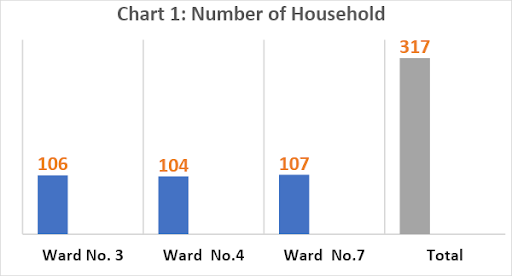
Altogether 317 out of 1330 households received the relief packages in four days. To give you a breakdown of wards, 106 houses of ward number 3, 104 of ward number 4 and 107 of ward number 7 collected the relief packages during the program.
The Year 2021
Then again, SDA responded to the second wave of the pandemic crisis in the affected communities with the Covid-19 Relief Distribution Program under the One Time Project (OTP). The distributed food materials could solve the immediate food scarcity problems in the communities during the second wave of Covid-19. The distribution program in 2021 was conducted during the monsoon to provide people with supplies to ease the potential food crisis created by floods and landslides on top of the covid – 19 pandemic.
First, it published a notice entailing information about relief supplies and forwarded it to rural municipalities and supporting wards. On the first day, thirty-two households of KRM ward-03 received relief supplies.
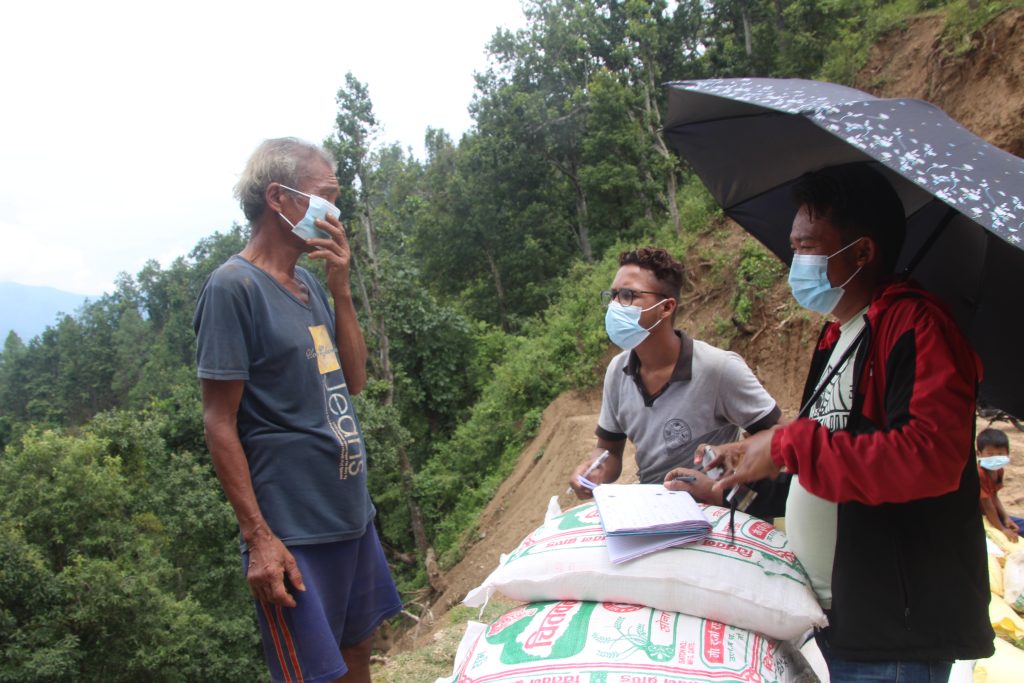
The relief distribution program ran from July 30 to August 7, 2021. By the end, five hundred and fourteen houses of KRM wards 3, 4, 7 and 8 received the relief supplies. The households were 128 from ward 3, 156 from ward 4, 130 from ward 7 and 100 from ward 8. Also, the recipient households include fifteen houses of SDA hostel girls of that time.
From the 514 households, the total number of individual beneficiaries was 2969. And, out of 2969, about 1459 were female, and 1510 were male. Regarding ethnicity, Chepang – 214, Tamang – 266, Dalits -17, Brahmin/Chhetri – 8, and Others – 7 houses benefited from the program. There were 1115 children under 18 years from all the recipient households. Of them, 587 were male, and 528 were female children.
Story of Kanchhi Maya Muktan
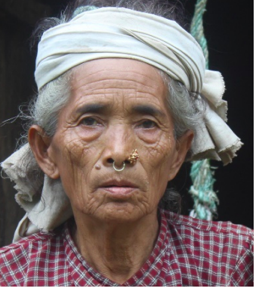
Among the individual beneficiaries was Kanchhi Maya Muktan, a 78 years old single woman. Having lost her son at the hopeful age of eighteen and her husband only two years ago, Kanchhi lives alone in Kailash-07, Bilaune.
With her daughters married off, Kanchhi does not have any members in her family. Alone, frail and old, she struggles to make a living. The neighbours sometimes help her by providing food and other materials.
While Kanchhi does have some lands in her name, they remain barren all the time since she is too old to work in the field. Her only source of income is the old-age allowances she receives from the government.
When the relief distribution program was in the planning phase, Kanchhi was in pain since the monsoon partially damaged her house. She did not have much food left to eat. The Covid-19 Relief Distribution Program solved her immediate problem of food scarcity.
The target of the program was people like Kanchhi Maya. Thus, with the help she received, it was visible that the program met its objectives.
“I am very thankful to SDA for the relief distribution program that alleviated my terrible situation.” Kanchhi further adds, “I had not had proper food in a month. I am happy to get help in this difficult situation.”
Response to COVID-19 Management
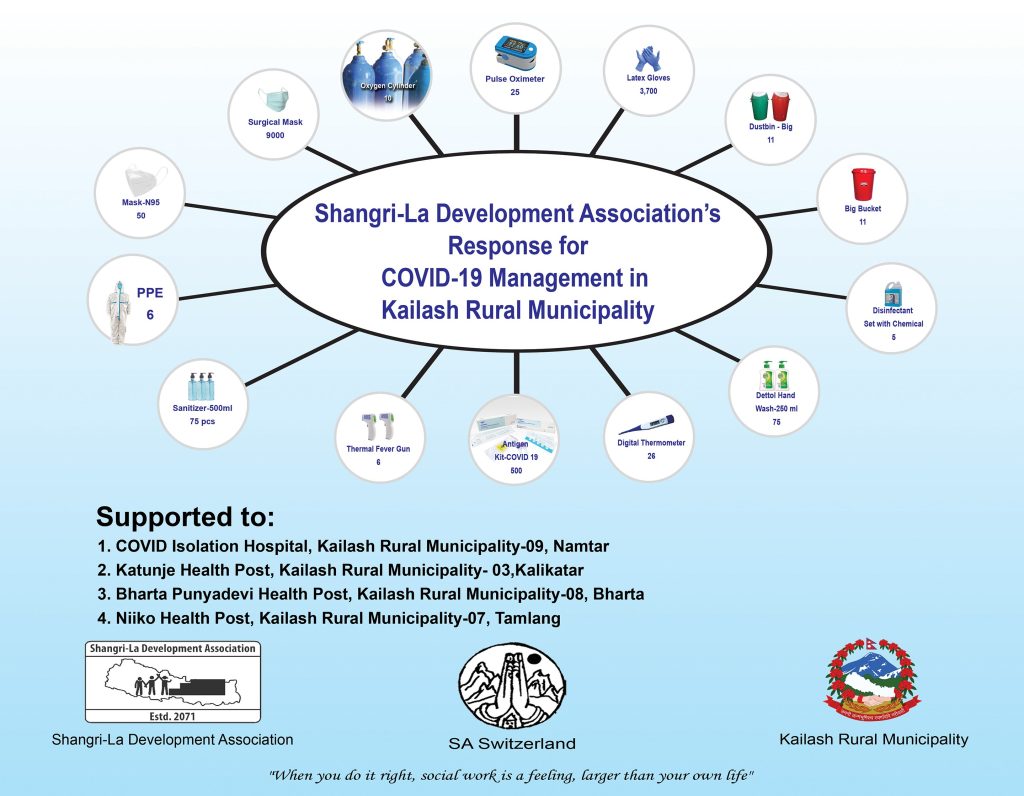
In December 2021, the Shangri-La Development Association responded to the Covid 19 management in Kailash Rural Municipality by providing materials to prevent and check the contraction of coronavirus. The response team handed over the equipment to three health posts, an isolation centre and Literacy Home.
Challenges
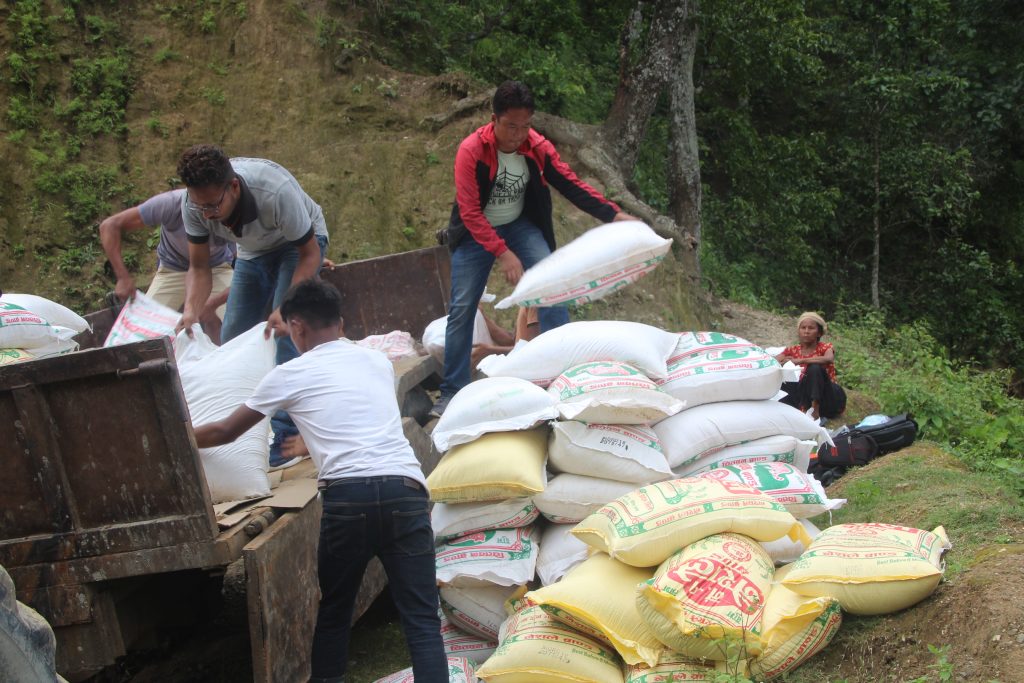
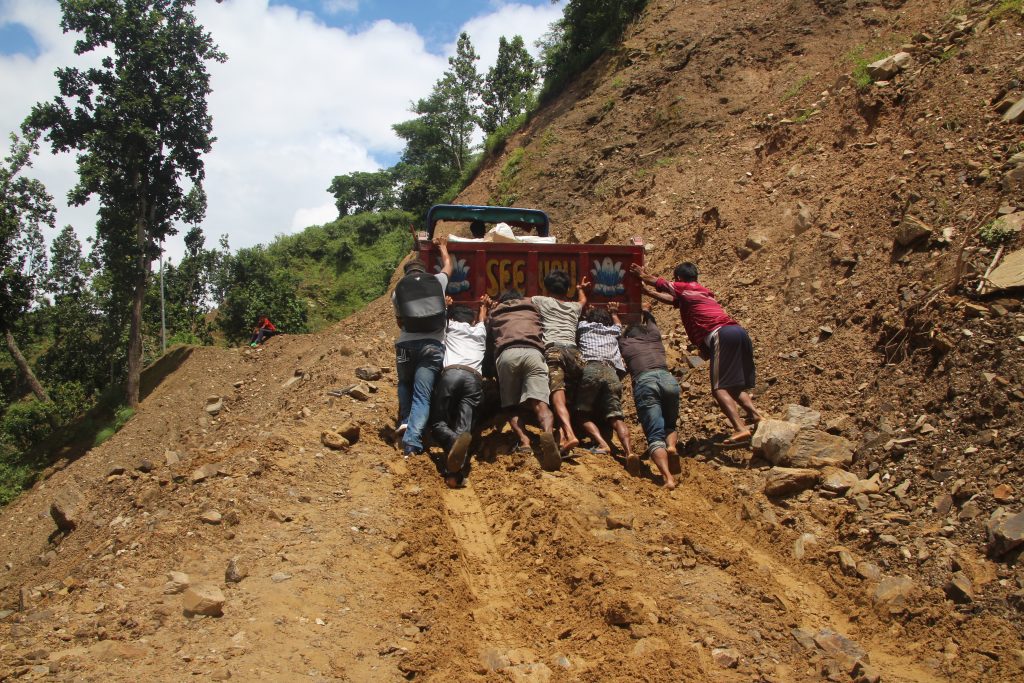
The COVID-19 Relief Distribution Program was not an easy task to implement within a limited period. Since everyone had to maintain physical distance, it was time-consuming. Likewise, managing vehicles to transport relief materials over far distances was difficult. Also, the local government gave less importance to relief distribution programs than other regular project activities of SDA.
Moreover, the limited household coverage left the folks from the community who did not receive the relief supplies dissatisfied. Furthermore, there were complications with the schedule and human resource management.
But, despite all of the ongoing issues, the team somehow managed and achieved the target. All staff had to give more time to manage and be involved in the field during the distribution of packages. The program was successful due to the hard work of staff, good communication, and continuous support from the SDA EC board, local government bodies and the communities.
Achievements
While there was room for improvement, the team met the expected efficiency in implementing the program, given the planning was done in a short period.
The Covid-19 Relief Distribution Program was made possible through coordination with vendors, rural municipalities and supporting wards. Locals and ward members showed a great deal of cooperation and helped in managing and distributing the materials. The executive committee of SDA engaged actively in implementing the program objectives from the beginning. Hence, all the selected households got food relief packages within the timeframe.
Teamwork, a success factor, is a must when it comes to carrying out programs at the community level. Every party from different levels engaged with their capacity and contributed actively to the relief distribution program. SDA involved the local government authorities to ensure that the distribution program has a long-term positive impact. It handed the responsibility of selecting the needy and poor households from each ward to the respective ward chairperson for effectiveness.
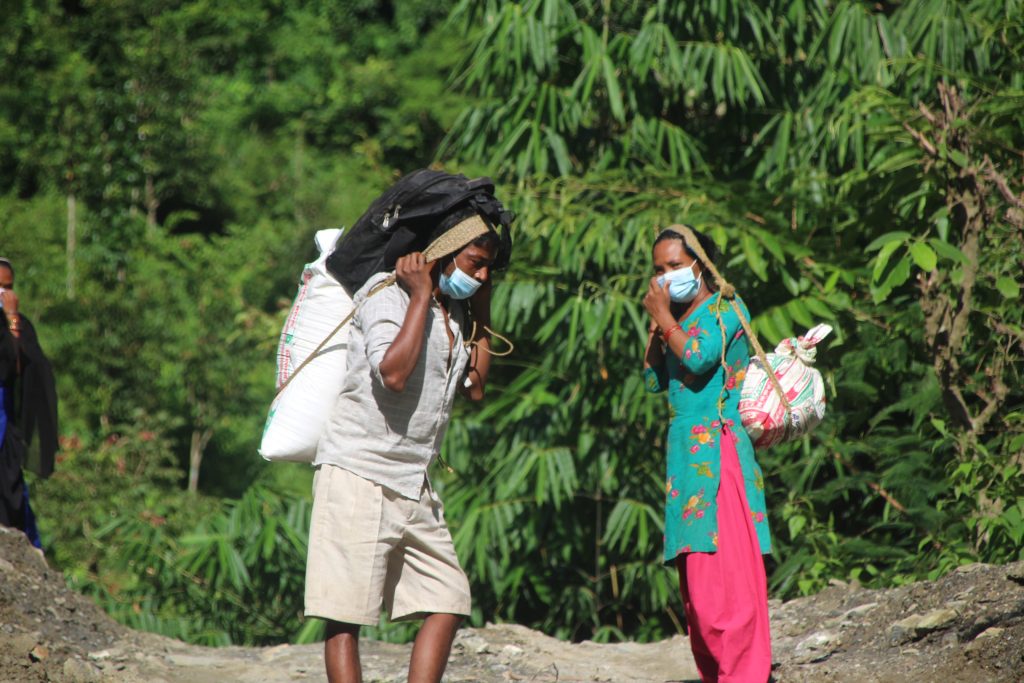
All of this culminated in the deserving households receiving relief supplies at the right time. Thus, the respective ward chairpersons thanked SDA with letters for successfully conducting the Relief Distribution Program in their wards.
Uncompromised Safety
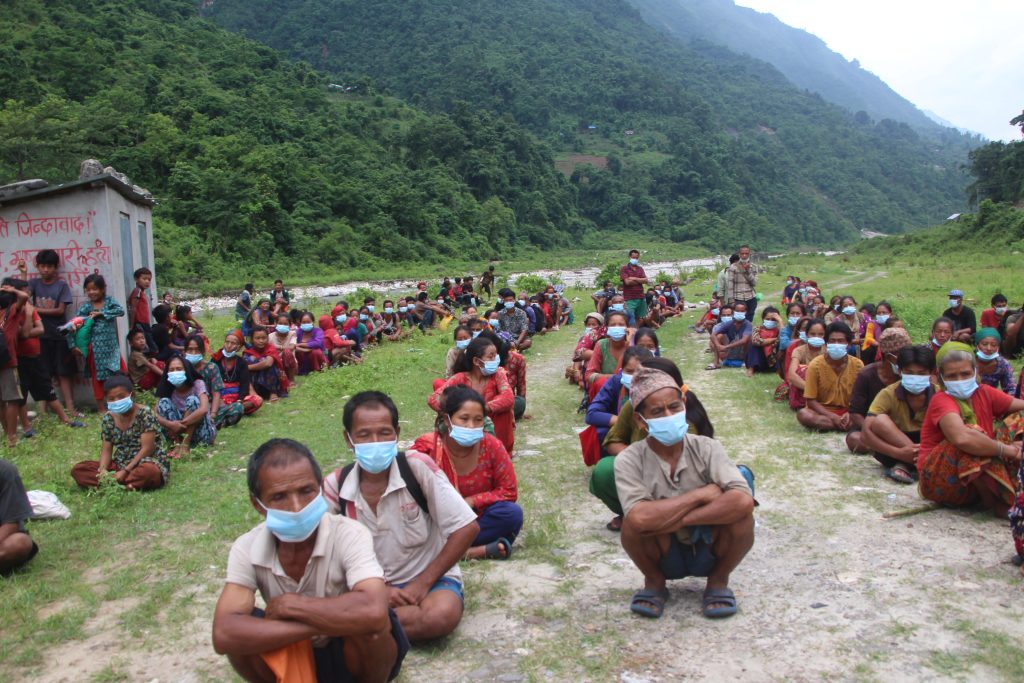
Every day, the program was conducted by following the protocols of Covid-19. The team distributed masks and sanitisers to everyone present.
Likewise, the team had assigned people to check whether people washed their hands with soap before entering the premises. They also placed chairs for physical distance during the program.
The team developed and posted safety guidelines on walls around the program area. They also ensured that everyone present followed safety norms and measures during the relief distribution programs.
Beyond the programs, SDA also implemented safety protocols in the field office. Literacy Home in Kalikatar was no stranger to the “new normal” brought by the virus. Hostel girls were in isolation, and everyone in and around followed Covid – 19 safety guidelines with utmost care.
Words from Stakeholders
“Once again, the SDA team came up with a great idea to support needy families with food relief packages. I thank them for their continuous support in this critical time.”
– Sukumaya Thing, Then Vice-Chairperson, Kailash Rural Municipality
“On behalf of KRM, I am thankful to the Shangri-La family for the COVID-19 relief distribution program to help disadvantaged households. The support came at the right time, and the people will value the relief packages.”
– Health Officer, Kailash Rural Municipality
Our Sincere Gratitude to
Kailash Rural Municipality (KRM)
SDA EC Board
Shangri-La Association, Switzerland
Govinda Association, Germany
KRM ward-3, 4, 7 & 8 Chairpersons
Ward Members
Stakeholders and the well-wishers
Sagun Kirana Store, Kalikatar
Beloved Beneficiaries