Child-Friendly School Taps: A Small Intervention with Big Impact
July 14, 2026
One Time Support Projects
View AllYou will be redirected to our partner organization's page.
On April 26, 2025, Shangri-La Development Association marked a significant milestone in its history — our 10th Anniversary program, titled, 10 Years of Impact: A Decade of Community Development, Emergency Relief, and Humanitarian Support, with. The program was more than just a celebration — it was a reflection on the work we have accomplished, the obstacles we faced along the way, as well as the positive change and impact we have managed to bring in the community. The event was attended by community stakeholders, partner organizations, government representatives, as well as representatives from various organizations that we have worked with in the past to bring our projects to fruition.
Shangri-La Development Association was established in November, 2015 by a group of youngsters, eager to give back to the community, and to create a positive impact in the country. Supported by partner organizations, Shangri-La Association in Switzerland and Govinda Association in Germany, we sought out those underrepresented communities and regions of Nepal that were in drastic need of support. With thorough research and two rounds of field surveys, we decided to base our projects in Kailash Rural Municipality, a highly remote, Chepang-majority community situated in Makwanpur district, where road access would be routinely cut off during the monsoon season. Soon after establishment, we also took over the Jumla Special Children Project, which provided inclusive education opportunities to deaf children in the remote, Himalayan region of Jumla.
Guided by visionary mentors like Achim Mettang and Rocco Umbescheidt, we established a multi-sectoral umbrella project that we titled the Shangri-La Sustainable Local Initiative (SSLI). Under this project, we would run activities in health, education, and agriculture sectors, with a single united goal of uplifting the living standards and capabilities of our beneficiaries.
In the 10 years since that time, SDA has become a household name in its project region due to the positive impact it has made in the community, known by all for the work we do to empower farmers, mothers, health workers, and students. Our 10th Anniversary event was a look back at it all — at the same time, it was also a turning point in our journey, not just in the milestone we had reached, but also in our journey ahead, adapting with the changing times.
Our efforts to highlight this journey was encapsulated in a format that went beyond just a formal program. Capturing the most significant moments from this 10-year journey, a series of canvases were put on display for visitors. The Memory Lane, as we called it, began with a decades-old photograph from Shangri-La Orphanage Home, where our founding members had grown up together. The group photo captured our founders in their teen years, at a time when Shangri-La Development Association was yet to be conceived of as an idea.
Another canvas showed a photograph of our founding Executive Committee members from the day SDA was formally chartered; another was a bird’s eye view of a greenery-filled Kalikatar Bazaar, captured in 2015, where we would later go on to build our Makwanpur field office. An image of a classroom filled with middle-aged people with their hands raised showed the moment in which we gained the trust of the Kailash natives to carry out the house reconstruction project following the devastating Nepal earthquake of 2015. Named the Shangri-La Reconstruction and Development Project (SRDP), it was an expansive house reconstruction project that spanned multiple districts, undertaken as a collaborative effort of a group of NGOs. Under SRDP, we would build 34 houses in Kailash Rural Municipality, providing housing for a total of 245 individuals.
In this way, the Memory Lane showcased significant moments in our journey including milestone moments in our various projects, ending up with a collage of some of our latest moments: a recent Annual General Meeting, and some significant departures from our team.
Following the Memory Lane were a series of stalls where attendees could symbolically interact with some of our projects: a tree stall featured displays of tree saplings that were grown at our own tree nursery at Achim’s Agriculture Field, the model organic farm that we operate at Kailash, feeding nearly 500 school students and 15 hostel girls in the process. Another stall featured reusable, environmentally-friendly sanitary pads that have become a lifeline for women in Kailash Rural Municipality. In a region where people are still resistant to receiving modern health and reproductive education, and the average financial status of a family keeps the women from opting for the standard choices in menstrual health, the reusable sanitary pads that we have introduced in the community have become a symbol of empowerment. These sanitary pads can be easily made at home and keeping them sanitized is also a convenient affair, leading to its adoption by many women in Kailash Rural Municipality.
Another stall displayed carpentry items brought over from Shangri-La Orphanage Home, built by its current students as part of a life skills training program named the Shangri-La Vocational Training Center. Even more materials to read and explore SDA’s impact were shared digitally through QR codes, as a humble attempt to promote climate-aware action and reduce the use of paper.
The formal session was opened by our Board Secretary, Dashrath Ghimire, who reflected upon the day as a symbol of SDA’s decade-long journey of “dedication, unity, and service.” In heartfelt tones, he shared a sense of pride upon succeeding in the organization’s vision of bringing prosperity and development to the community. He ended his opening address with a note of gratitude towards all the attendees and the supporters and well-wishers who had contributed to SDA’s success, from its earliest days to the present.
Chairperson of Kailash Rural Municipality, Lok Bahadur Moktan, then signalled the start of the formal program by lighting the ceremonial lamp — a Nepali tradition that precedes formal events.
The most significant moments in the formal program was when community members from our project regions — individuals who had directly benefited from our programs, and seen our work first-hand in their communities — took to the stage to share their own stories. The first of these speakers was Ram Maya Rijal, an active Female Community Health Volunteer who serves under Katunje Health Post in Kalikatar, at the heart of Kailash Rural Municipality. FCHVs are instrumental in the rural health sector of Nepal, and are responsible for connecting community members to the local health services, and as such are deeply in tune with the issues in their area’s health sector. Rijal shared her experience traversing the hills of Kailash in the course of her duties, remarking how “SDA has walked hand-in-hand with us and taught us a lot about how to do our work.”
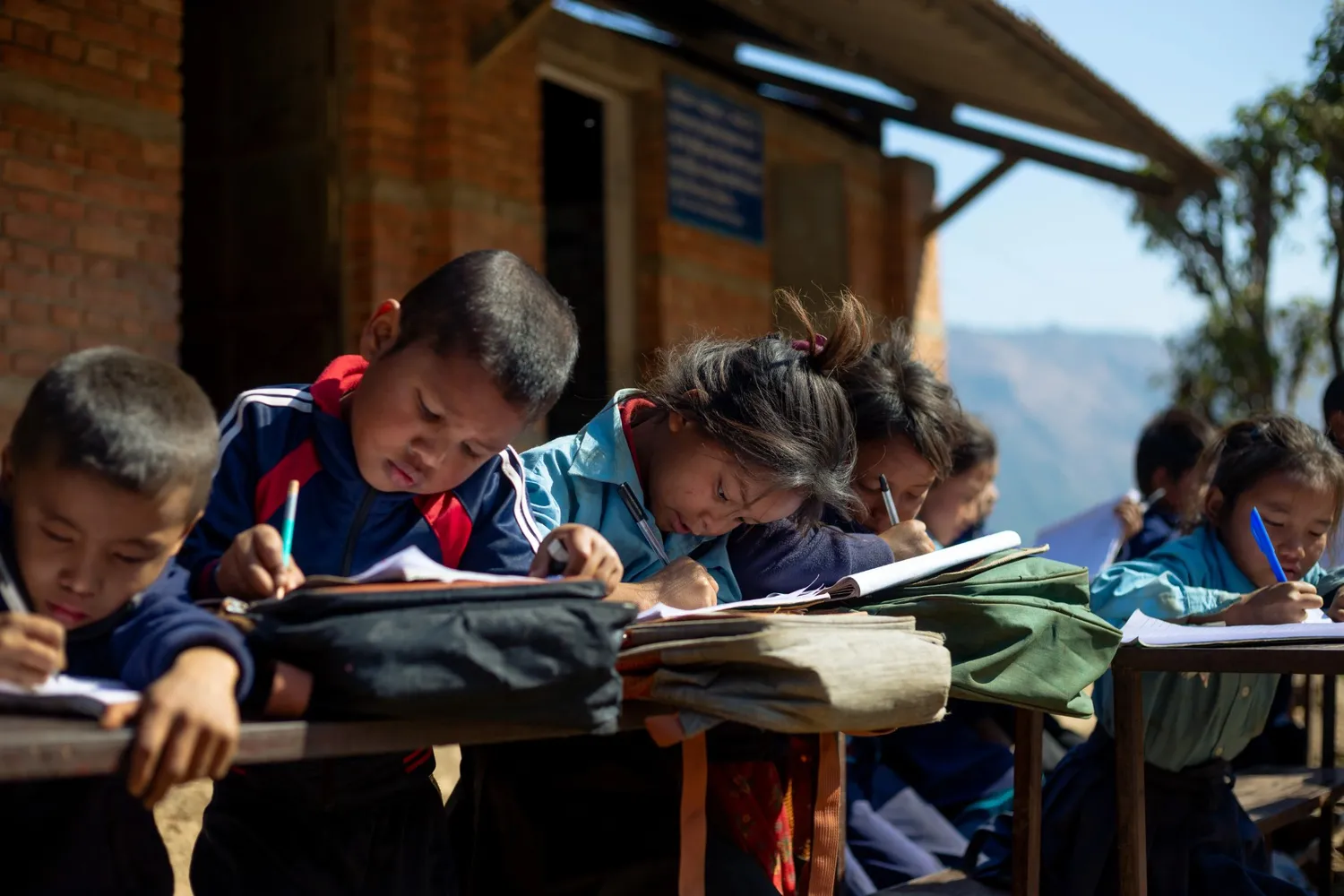
The next speaker was 16-year-old Chameli Maya Chepang, one of the girls from the SDA Literacy Home who has recently completed her SEE examinations. The Hostel Project, which is housed in the Literacy Home, serves to directly support school-aged girls who have dropped out of school with housing and schooling, and provides them with all the resources they need to complete school. She related to the audience the story of her family, and how she ended up at the Literacy Home. Chameli Maya’s family had been able to send her to school till Class 5, in the nearby Deutish Primary School — one of the community schools that receive complete support for uniforms, stationeries, and mid-day meals from SDA. However, the school only offered classes till Class 5, and moving forward with her schooling meant walking for hours as a child to the nearest available secondary school. She was forced to quit schooling; her parents couldn’t afford the time to escort her to and from school, nor could they afford to rent a room near the secondary school itself.
At this juncture, it was the opportunity to join the SDA Hostel Project, and live at the Literacy Home, that allowed her to continue with her education. With our support, she was enrolled in Bhawani Secondary School, situated near the Literacy Home. “There are 15 of us at the hostel,” she shared, “with the facilities provided by SDA, we’ve been moving forward in our education steadily. Since I joined the hostel, my studies have been improving every year, until I earned the first rank in my class in the class exams of Grade 10.”
The next speaker was one of our former students from the Jumla Special Children Project. Durga Laxmi Rokaya had come to be a part of JSCP in 2016, the same year that the project was grandfathered into SDA. Like all the other students of JSCP, she was completely deaf, born in the mountainous region of Jumla. With the right support from SDA, today she is studying for her bachelor’s degree in Kathmandu. She related the story of how the project became instrumental in helping her gain the right opportunities in life. “SDA supported me from the year 2016 to 2021, in the course of which I was eventually able to study B.Ed,” she shared, “we used to study in inclusive classes alongside with students who could hear. The organization provided us with sign language teachers, allowing us to gain an education. Shangri-La Development Association has supported me greatly in helping me reach the place I am at today.”
A special moment from the formal program was when Roberto Presa, CFO and former Chairperson of Shangri-La Association, Switzerland, presented SDA with a special gift to commemorate the occasion — a traditional cowbell from Switzerland, on behalf of Shangri-La Association, Switzerland, and Govinda Association, Germany. The loud, sonorous ring of the bell was the “sound of your impact”, he declared, a gift “to remember this very occasion of the first decade, of the impact you’ve generated and the sounds you have brought out to Nepal. We’re thanking you for all the dedication and all the support. And we’re honored to be able to walk along your side throughout this fantastic journey and we hope that it will continue and that it will generate lots of more impact.”
Department Chief of Social Welfare Council, Dipendra Pant, reminisced during the event about his own experiences with Shangri-La Development Association. In the early years of the organization, he had been to our project location in Kalikatar as part of an SWC monitoring visit, during which he could observe our work firsthand. He related his experiences observing our work in different sectors, such as Achim’s Agriculture Field as a model organic farm under the Agriculture Project, as well as the Hostel Project, and reflected that the foundations upon which these activities were conducted were noteworthy and forward-thinking.
“As per my experience, I would like to express that there has been a genuine impact,” he stated, “the visuals and video that are shared act as a testament. Along with that, we have listened today from the actual beneficiaries about their thoughts and feelings.” He also commended the organization for supporting Nepal government’s development plans by working with marginalized communities in remote areas.
Chairperson of Kailash Rural Municipality, Lok Bahadur Moktan, pointed out the remote nature of the region and expressed gratitude for SDA for its multisectoral projects. “On behalf of Kailash Rural Municipality, I would like to thank Shangri-La Development Association for the incomparable work it has done to improve the reach of education the children belonging to marginalized and impoverished communities, to improve the reach of health services, to invest in the agriculture sector, and to preserve the environmental integrity of this region.”
The event was also a unique occasion to commemorate all the individuals and organizations who played instrumental roles in the success of SDA’s developmental work. As an organization that has worked closely with the community, our team is full of long-serving members who have been with us for five years or more. The Anniversary was a special occasion in which to recognize their contributions.
Similarly, we offered tokens of love for the various organizations and individuals who had an especially meaningful role in our journey. Of special significance was the token dedicated to Rocco Umbescheidt and the posthumous token given to Achim Mettang, the two primary mentor figures who guided us in our early days.In between, the girls from the SDA Literacy Home and two of the JSCP students also delivered dance performances which were well received by the audience members. A 20-minute video capturing the heartfelt stories of community members in SDA’s project area was also a highlight that showcased how the organization had succeeded in improving lives.
The formal program was finally closed by SDA’s former Chairperson of eight years, Jay Shankar Upadhyay. Currently serving as Advisor to the organization, he closed the program by individually thanking all those organizations and individuals whose contributions have been invaluable to SDA’s journey — the mentors, Achyut Uncle and Dikendra Uncle, were key mentions. He also expressed a heartfelt thanks to Shangri-La Orphanage Home, stating “this is only the blooming of the flower that you watered and took care of for 20 years.”
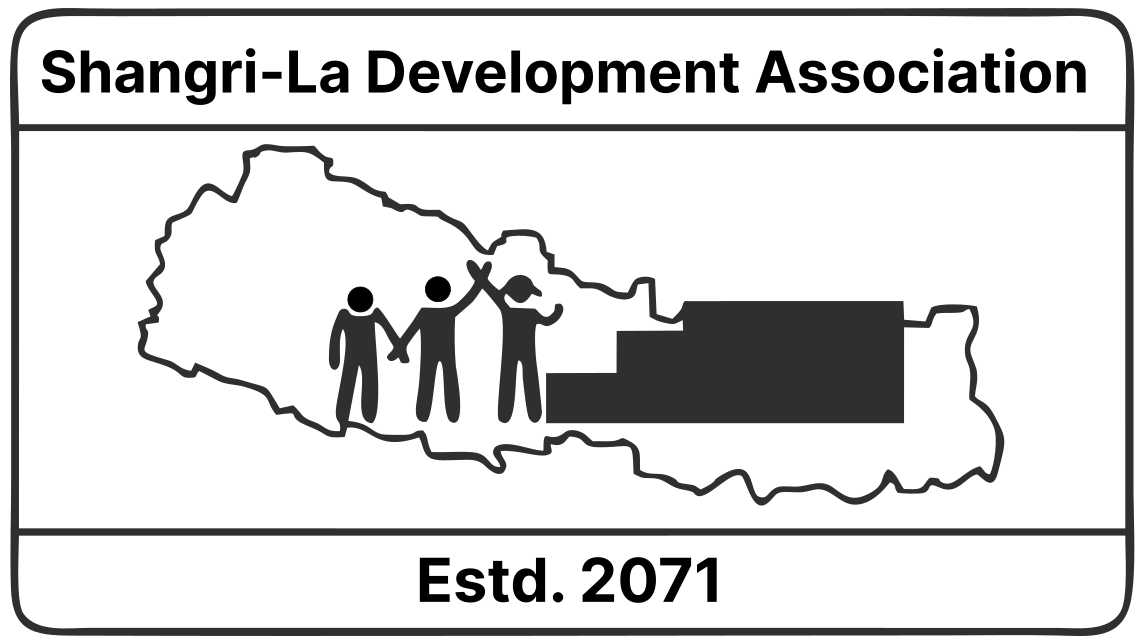
He also took a moment to explain the deep significance behind SDA’s logo, which encapsulated the history of its founders and the idea which led to the organization’s birth. “If you look at our organization’s logo, you will find three individuals walking up steps on Nepal’s map, while holding hands,” he explained, “we started this organization because we felt that it isn’t just enough that we have become capable. We wanted the country as a whole to become capable, and started this organization to take forward that mission.”
Following the closing speech, an hour-long musical session followed. Led by the instrumental world fusion band, Ashish Maharjan and The Triplets, the musical session was the space for all the participants to revel in old relationships, and the joy of togetherness. Upon familiar folk tunes, attendees soon filled the space with joyous dance, and it truly became a moment to remember for years into the future.
Today, our success in the developmental and humanitarian work that we do belies our humble beginnings: where a group of youngsters, newly entering into adult life, decided to create a vehicle for social development, dedicated for the most underprivileged and impoverished communities of Nepal.